 Sanjay Verma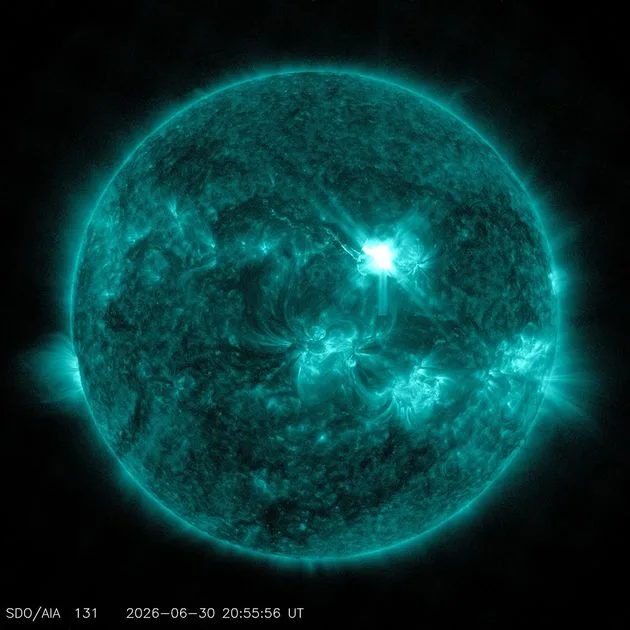
In This Article
- A Sudden Flash Nobody Saw Coming
- Why Scientists Grade Every Flare Like a Report Card
- How Does a Flare 93 Million Miles Away Affect Life on Earth?
- What This Means Beyond the Headlines
- What Scientists Still Don't Know About This Flare
Picture a fireball wider than Earth, sitting 93 million miles away, letting out a blast strong enough to disturb radios on the other side of the planet. That is roughly what happened on June 30, 2026, when the Sun released a powerful solar flare that peaked at 4:50 p.m. ET. NASA's Solar Dynamics Observatory, a spacecraft that watches the Sun every second of every day, caught the whole eruption on camera. Scientists classified it as an X1.1 flare, and this one is worth paying attention to.
A Sudden Flash Nobody Saw Coming
For most of the day, the Sun looked the way it usually does: a calm, glowing ball dotted with a few dark sunspots. Then, in a matter of minutes, one small patch of the surface let go of a huge amount of stored magnetic energy. The result was a solar flare, a sudden burst of light and radiation strong enough to briefly outshine the rest of the Sun in certain wavelengths. NASA's Solar Dynamics Observatory captured it as a bright white flash in the upper right portion of the Sun, glowing against the teal-colored image the spacecraft uses to highlight extremely hot material.
Why Scientists Grade Every Flare Like a Report Card
Every flare gets two labels: a letter and a number. The letter shows how powerful the flare is overall. The number, running from 1 up to just under 10, fine-tunes that strength within the letter's range. This eruption came in as X1.1, meaning it sits near the low end of the most powerful class, but it is still an X-class event, the same category that produces the strongest radio blackouts and can send blasts of solar material racing toward Earth. Solar physicists watching the sunspot cluster behind the flare, catalogued as Active Region AR4479, had flagged it days earlier as unusually complex and primed to fire.
How Does a Flare 93 Million Miles Away Affect Life on Earth?
Light and radiation from a flare travel at the speed of light, so the effects on Earth begin the instant the flare is observed, with no delay and no warning. That burst of X-rays and extreme ultraviolet light hits the sunlit side of Earth's upper atmosphere and ionizes it more heavily than usual. High-frequency radio waves, the kind used for aviation, shipping, and amateur radio, normally bounce off the upper atmosphere to travel long distances. When the lower ionosphere gets overcharged, causing what scientists call a radio blackout, those signals get absorbed instead of bounced, and operators lose contact for anywhere from a few minutes to about an hour.
"...causes real effects at Earth and throughout our solar system."
Jamie Favors, NASA Space Weather Program · NASA, 2024What This Means Beyond the Headlines
None of this means people need to worry every time the Sun flares. Most X-class events like this one cause a brief, regional radio disruption and nothing more dramatic than a few dropped high-frequency signals. What makes this flare newsworthy is timing. It arrived during an unusually active stretch of Solar Cycle 25, the Sun's roughly eleven-year rhythm of calm and storm. NASA and NOAA have already reported that this cycle produced more sunspots than forecasters originally expected, and flares of this size keep arriving even as the cycle edges past its peak.
What Scientists Still Don't Know About This Flare
Forecasters are now watching to see whether the eruption launched a coronal mass ejection, a separate cloud of solar material that can take one to three days to reach Earth and spark a geomagnetic storm. Early tracking pointed to a CME associated with the event, though its exact speed, direction, and whether it will strike Earth head-on are still being confirmed by NOAA's Space Weather Prediction Center. If it arrives at the right angle, skywatchers at high latitudes could see brighter auroras within days. It is not just a story about sunspots and radio static. It is a reminder that the calm daylight people take for granted comes from a star that never really rests.
- Strong class, modest number: X1.1 sits near the low end of the most powerful flare category, yet it still triggered a real radio disruption.
- No warning, no delay: The flare's radiation reached Earth's atmosphere instantly, at the speed of light, disrupting long-range radio signals within minutes.
- Part of a busy cycle: This eruption adds to a growing pattern of strong solar activity during Solar Cycle 25.
"Solar Cycle 25 sunspot activity has slightly exceeded expectations." Lisa Upton, Southwest Research Institute, NASA Science, 2024.
📄 Source & Citation
Primary Source: Thomas, V. (2026). Sun Releases Strong Flare. NASA Science, Solar Cycle 25 Blog. https://science.nasa.gov/blogs/solar-cycle-25/2026/06/30/sun-releases-strong-flare-11/
Authors & Affiliations: Vanessa Thomas, NASA Science; imagery from NASA's Solar Dynamics Observatory mission team
Data & Code: Real-time flare and space weather data available via NOAA's Space Weather Prediction Center (spaceweather.gov) and NASA's Solar Dynamics Observatory archive
Key Themes: Solar flares · Solar Cycle 25 · Space weather · Radio blackouts · Solar Dynamics Observatory
Supporting References:
[1] NOAA/NWS Space Weather Prediction Center. Solar Flares (Radio Blackouts). spaceweather.gov.
[2] NASA Science (2024). NASA, NOAA: Sun Reaches Maximum Phase in 11-Year Solar Cycle.
[3] The Watchers (2026). X1.0 Solar Flare Erupts from Geoeffective Region 4455, June 3, 2026.
No comments yet. Be the first to share your thoughts.
Leave a Comment