 Krishan Gopal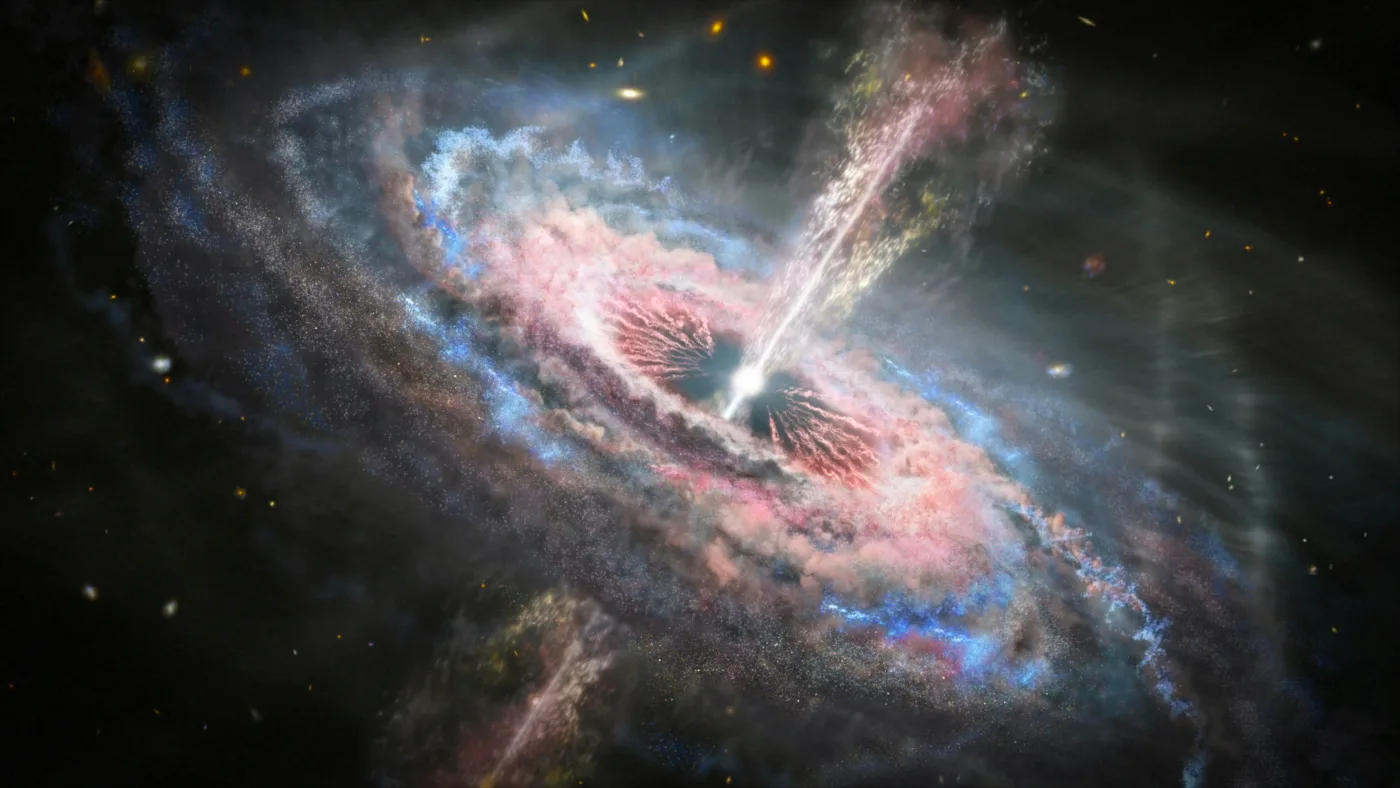
In This Article
- A Giant Cloud That Shouldn't Exist (But Does)
- The Black Hole That Took a 100‑Million‑Year Nap
- Why Is This Tail Acting Backwards?
- The Hidden Fuel Tank at the Center
- What's Next for This Cosmic Mystery
Picture a cosmic fountain. But instead of water, a supermassive black hole shoots out beams of invisible energy. These beams travel for millions of light‑years, painting giant glowing clouds in space. Now imagine that fountain turning off. The cloud just sits there, slowly fading, like embers after a fire. Then — after 100 million years of silence — the fountain suddenly turns back on. A fresh new beam blasts right through the middle of the old, dead cloud. That's not science fiction. Astronomers just found exactly this scene playing out in a galaxy called J1007+3540. And it's teaching us something unexpected about how black holes live, die, and wake up again.
A Giant Cloud That Shouldn't Exist (But Does)
Most big galaxies have a black hole at the center. When stuff falls into it, the black hole spits out a tiny fraction as twin "jets" of fast‑moving particles. These jets inflate enormous bubbles of radio‑wave light — think of them as smoke rings the size of entire galaxies. J1007+3540 is one of the largest ever found. Its cloud stretches 1.45 million light‑years across. That's like stacking 15 Milky Ways end to end. But here's the weird part: earlier surveys missed it. Why? Because it's sitting inside a crowded city of galaxies, and the thin, hot wind blowing between those galaxies has battered the cloud into a lopsided, broken shape. It took the ultrasensitive LOFAR telescope in Europe and India's upgraded Giant Metrewave Radio Telescope (uGMRT) to see the full, messy picture.
The Black Hole That Took a 100‑Million‑Year Nap
Look closely at the cloud around J1007+3540. You'll notice two completely different layers. Right near the middle, there's a bright, compact set of beams. That's the "new" jet — the fountain that's running right now. But wrapped around it is a vast, fuzzy, northern cloud. That cloud is a ghost. By measuring how the radio "color" of the cloud changes (just like hot coals change from red to dark as they cool), astronomers can tell how long it's been since the black hole stopped feeding it. The answer? 260 million years. The new inner beams are only 140 million years old. That means this black hole was silent for at least 120 million years. Then, for reasons we don't fully understand, it roared back to life.
It's like finding an ancient, weathered tree stump with a fresh green shoot growing right out of the middle. The black hole died. Then it came back. But that's not even the strangest part.
Why Is This Tail Acting Backwards?
Stretching out from the galaxy's south side is a long, faint tail of radio glow. There's a sharp kink in it — like a bent garden hose. Before the kink, the cloud is so faint and "cold" (in radio terms) that it's almost invisible. It's clearly ancient, dead material. But after the kink? The tail suddenly brightens. The radio color shifts to a younger, more energetic shade. And the "cooling clock" says this outer part is only 100 million years old — younger than the material closer to the black hole. That's backwards. It's like finding an ice cube at the bottom of a fire pit. What's going on?
"The extended tail displays a flat spectrum and a younger age compared to the inner parts... This suggests the old plasma is getting a second wind, likely from shockwaves in the cluster."
— S. Kumari et al. · MNRAS, 2026Think of it like a rock concert. The band stops playing. The crowd goes quiet. Then a giant speaker falls over and hits the floor with a massive THUMP. That shockwave ripples through the crowd, and suddenly everyone is jumping again. That's what's happening here. The beam from the galaxy is plowing into a wall of hot, thin wind between galaxies. The collision creates a shockwave that literally re‑energizes the old, tired electrons. It gives the ghost cloud a brand new glow.
The Hidden Fuel Tank at the Center
What kind of engine can die and restart like this? The black hole at the heart of J1007+3540 is a true heavyweight — 3 billion times the mass of our Sun. That's nearly a thousand times heavier than the black hole at the center of the Milky Way. And despite its violent history, it's currently spinning quite slowly. It's like a giant flywheel that's run down. The galaxy itself is old and red, but it's hiding a secret: thick, choking dust. So much dust that the starlight can't escape. Only infrared telescopes can see the glow of new stars being born inside that dusty cocoon. That dust and gas is the fuel tank. Every hundred million years or so, a clump of it falls into the black hole. The engine chokes, sputters, and fires out a new beam. Then the cycle repeats.
What's Next for This Cosmic Mystery
This is just the beginning. The team that found J1007+3540 has over 20 more of these distorted, messy galaxies in their sample. But there's a big piece of the puzzle missing: X‑ray vision. The shockwave that's re‑energizing the tail should be screaming in X‑rays. Right now, the data from the eROSITA telescope shows a faint glow of hot gas, but it's too blurry to see the actual shock front. Future observations with NASA's Chandra X‑ray Observatory could actually image the collision. If we can see the shockwave, we can measure exactly how much energy is being pumped back into that ghostly tail. It's a story of death and rebirth written across a million light‑years. And we've only just started reading the first page.
- Black Holes Nap, Then Wake Up — This galaxy shows clear evidence of two separate eruptions, separated by over 100 million years of silence.
- Old Clouds Can Get "Younger" — A shockwave from the jet slamming into surrounding gas is literally re‑energizing a dead cloud, making it glow like new.
- Dust Hides the Fuel — The galaxy looks quiet and old, but it's packed with dusty gas that will eventually feed the black hole again.
"The bent jets, the ancient back‑flow, and the strangely young tail all point to a complex dance between the black hole and the hot wind inside the galaxy cluster." — S. Kumari et al., MNRAS, 2026.
📄 Source & Citation
Primary Source: Kumari S. et al. (2026). "J1007+3540: A giant radio galaxy with episodic jet activity and evidence of re-acceleration in a cluster environment." Monthly Notices of the Royal Astronomical Society (submitted). Preprint: staf2038.
Authors & Affiliations: S. Kumari (Lead Author), S. Pal, et al. Manipal Centre for Natural Sciences, India & collaborating institutions.
Data & Code: LoTSS DR2 data available at https://lofar-surveys.org. uGMRT data available via GMRT Online Archive (Proposal 45_002).
Key Themes: Black Hole Restart · Cosmic Jets · Galaxy Clusters · LOFAR · uGMRT · Radio Astronomy
Supporting References:
[1] Schoenmakers A.P. et al. (2000). "A new sample of giant radio galaxies from the WENSS survey." MNRAS, 315(2):371.
[2] Shimwell T.W. et al. (2022). "The LOFAR Two-metre Sky Survey." A&A, 659:A1.
[3] Hardcastle M.J. & Krause M.G.H. (2013). "Numerical modelling of radio lobes in clusters." MNRAS, 430(1):174.
No comments yet. Be the first to share your thoughts.
Leave a Comment