 Sanjay Verma
In This Article
- Your Quick-Glance Events Calendar for June
- Venus and Jupiter Side by Side — What Is a Conjunction?
- How Does the Moon Block Venus on June 17?
- The Summer Solstice — Why June 21 Is Special
- The Summer Triangle and Deep-Sky Treasures to Hunt
Step outside on any clear evening this June and look west — you will see something that not everyone realises they can see with their own eyes: two planets glowing like steady, bright lamps in the darkening sky. June 2026 is one of the richest months of the year for June 2026 skywatching, packed with a rare planetary meetup, a Moon-covers-Venus event, the official start of summer, and a rising parade of star clusters and glowing nebulae that reward anyone patient enough to let their eyes adjust to the dark.
Your Quick-Glance Events Calendar for June
Not sure where to start? Here is every major event this month at a glance, in the order it happens. The rest of this article explains each one in plain language.
- June 9 Venus and Jupiter conjunction — the two planets appear very close together in the western sky after sunset. Look west about 30–45 minutes after the Sun goes down.
- June 11–15 Mercury joins the scene — a third planet appears low on the western horizon, creating a mini planet parade. You will need a clear, unobstructed view to the west.
- June 17 Moon passes in front of Venus — called a lunar occultation. Visible from parts of the United States, Canada, Brazil, and Venezuela. Safety note applies — read Section 3 before watching.
- June 21 Summer Solstice — the longest day of the year in the Northern Hemisphere and the official start of astronomical summer, at 1:24 a.m. Pacific Time.
- All month Summer Triangle rises — three brilliant stars form a giant triangle in the eastern sky, framing some of the best deep-sky objects you can target with a small telescope.
Venus and Jupiter Side by Side — What Is a Conjunction?
Imagine two ships on the ocean. They are hundreds of kilometres apart, but when you look from the shore, they seem to overlap. That is exactly what a planetary conjunction is. Venus and Jupiter are not actually close to each other — they are separated by hundreds of millions of kilometres of empty space. But on June 9, their paths line up from Earth's perspective so they appear to sit side by side in the sky.
Venus will be the brighter of the two — it is almost always the brightest object in the night sky after the Moon. Jupiter will be close beside it, large and steady, without the twinkling flicker that stars produce. Both are visible with the naked eye. No telescope, no app, no special knowledge required.
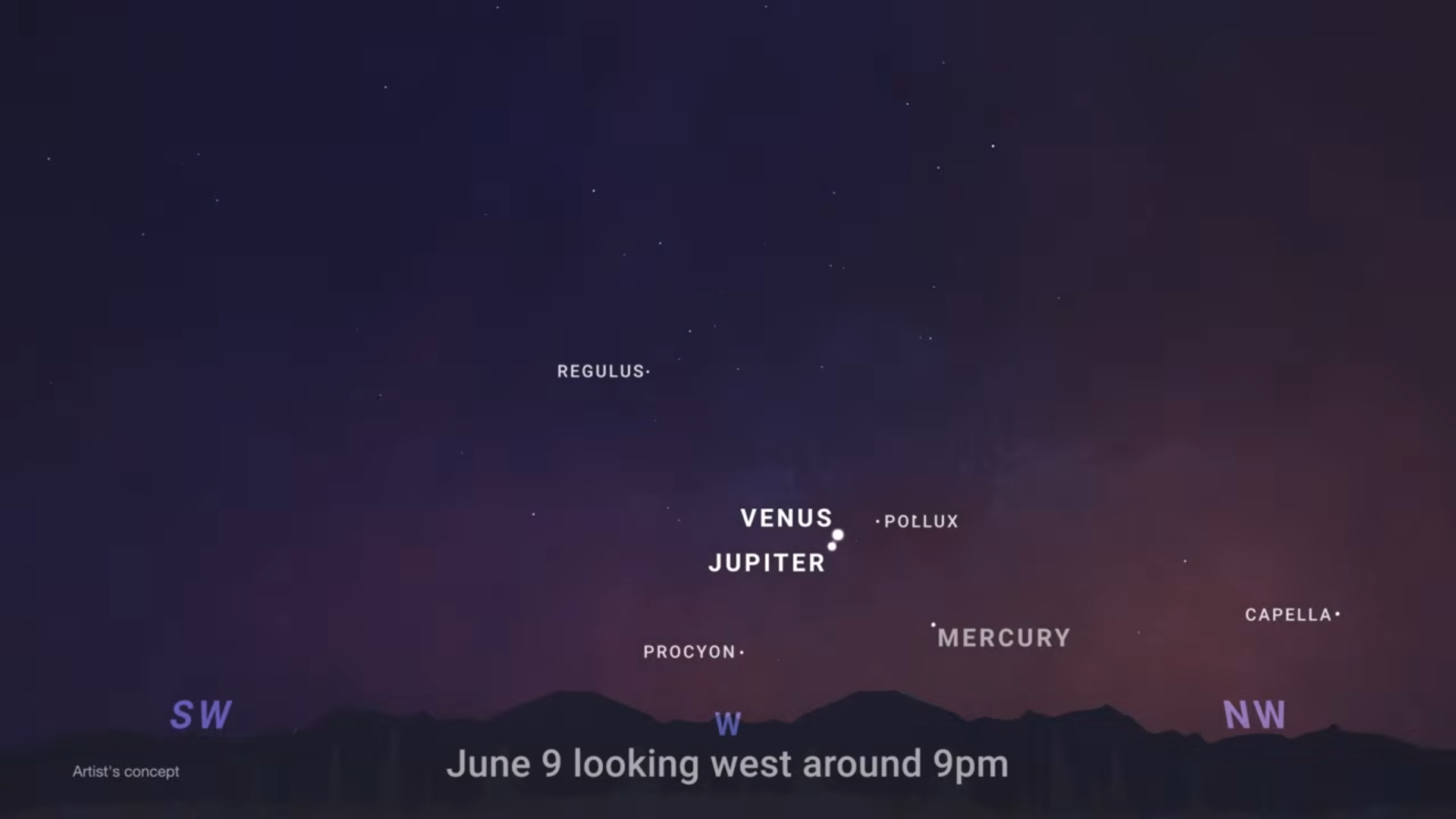
Sky chart: Western sky, 9 pm June 9, 2026. Venus and Jupiter in close conjunction near the horizon. Mercury visible lower right. NASA/JPL-Caltech.
From June 11 through June 15, a third planet joins in. Mercury — the smallest and fastest planet in our solar system — appears low on the horizon to the right of Venus and Jupiter. This happens because all the planets orbit the Sun along nearly the same flat path in space, called the ecliptic. From Earth, that path looks like an invisible line across the sky, and planets always appear along it. So when several planets are on the same side of the Sun as Earth, they can bunch together in a small patch of sky.
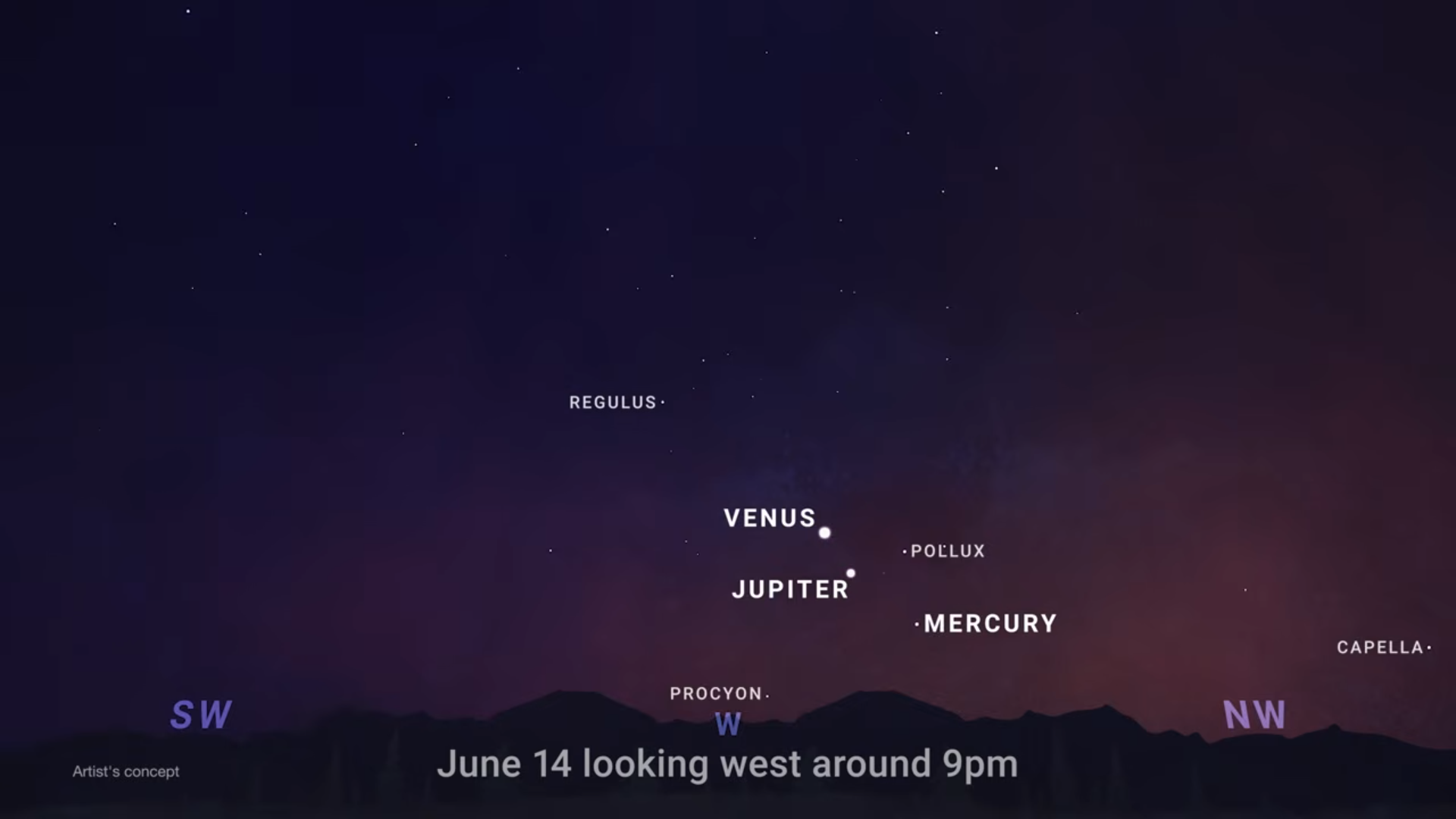
Sky chart: Western sky, 9 pm June 14, 2026. Mercury joins Venus and Jupiter in a mini planet parade. NASA/JPL-Caltech.
Mercury is the hardest of the three to spot — it sits low, close to the bright glow left by the setting Sun. A clear, flat horizon to the west gives you the best chance. The reward is worth it: three planets with the naked eye, lined up above the sunset glow like a row of lights switching on one by one.
How Does the Moon Block Venus on June 17?
On the morning of June 17, something rarer happens. The Moon swings across the sky and passes directly in front of Venus, hiding it completely from view for a short time. Watch carefully and Venus simply vanishes — swallowed by the bright edge of the Moon — then reappears on the other side.
This event is called a lunar occultation. It is visible from parts of the United States, Canada, Brazil, and Venezuela. If you are outside this viewing path, you will still see the Moon and Venus sitting very close together, which is beautiful on its own.
"From some locations the Moon will pass in front of Venus. Venus will look like it disappears behind the Moon, then reappears later."
— Raquel Villanueva, NASA Jet Propulsion Laboratory · NASA What's Up, June 2026For most people, the evening of June 17 still delivers a striking sight: the crescent Moon hanging beside the glowing dot of Venus in the western sky after sunset. That pairing alone — even without the full occultation — is one of the most photogenic skywatching moments of the year. So that answers what to watch for when it comes to June 2026 skywatching.
The Summer Solstice — Why June 21 Is Special
Picture the Earth as a slightly tilted ball, leaning as it travels around the Sun. Once a year, the Northern Hemisphere tilts as far toward the Sun as it ever gets. That moment is the summer solstice — and in 2026 it falls on Sunday, June 21, at 1:24 a.m. Pacific Time.
On that day, the Sun rises earlier, climbs higher in the sky, and sets later than on any other day of the year in the Northern Hemisphere. The further north you live, the more dramatic this is. Near the Arctic Circle, the Sun barely dips below the horizon at all. In the Southern Hemisphere, June 21 marks the opposite: the winter solstice, the shortest day of the year.
The solstice has no special viewing event in itself, but it marks a turning point in what the night sky offers. From here on, the great summer constellations climb higher and earlier. And with that comes the most rewarding deep-sky season of the year.
The Summer Triangle and Deep-Sky Treasures to Hunt
Once the sky darkens after the June solstice, look east. Three very bright stars will be climbing: Vega, Altair, and Deneb. They form a large, easy-to-spot triangle shape called the Summer Triangle — not a constellation, but a pattern so obvious that even first-time stargazers find it on their first try.
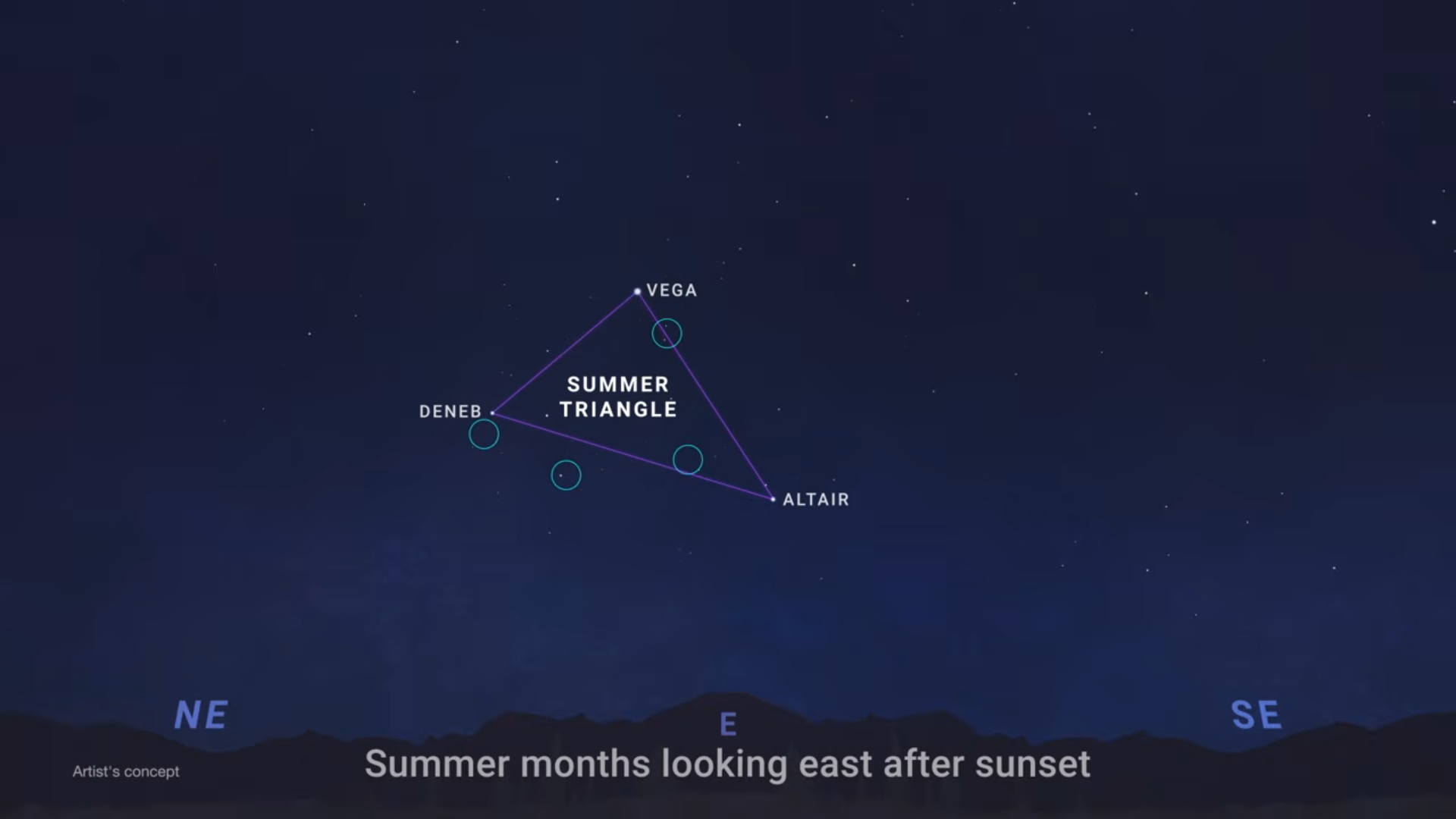
The Summer Triangle rises in the east on summer evenings. Vega is the brightest of the three stars. NASA/JPL-Caltech.
Vega is the brightest of the three, a brilliant blue-white star about 25 light-years away. Altair is the closest — just 17 light-years from Earth — and rotates so fast that it bulges outward at its equator. Deneb is the most distant by far and would be one of the most luminous stars we know of, shining with the power of roughly 100,000 Suns from about 2,600 light-years away.
But the real treasures are hiding inside the triangle, and here is where a small telescope turns the night sky into something else entirely.
The Dumbbell Nebula, also known as Messier 27, was the very first planetary nebula ever discovered — back in 1764. It is the glowing remains of a dead star, a shell of gas still expanding outward thousands of years after the star at its centre ran out of fuel. Through a small telescope it looks like a faint, oval puff of smoke. Through a larger telescope or in a long-exposure photograph, its structure becomes unmistakable. The Ring Nebula, in the constellation Lyra just below Vega, shows a similar scene: a dying star wrapped in a perfect ring of glowing gas.
The North America Nebula and the Veil Nebula are best targets for astrophotographers. They are too faint to see clearly by eye but respond beautifully to camera sensors with long exposures, revealing structures that look like continents and curtains of light.
"These objects reveal glowing gas, dying stars, and stellar nurseries in our galaxy." — Raquel Villanueva, NASA JPL, June 2026.
None of this requires expensive equipment or a dark mountaintop. Venus and Jupiter need only your eyes. A pair of binoculars reveals Jupiter's four brightest moons as tiny dots of light. A modest telescope opens the Dumbbell and Ring Nebulae. And all of it is happening right now — above every rooftop, every field, every balcony on Earth. June 2026 is simply one of those months when the sky decides to show off, and the only thing left to do is look up.
June 2026 Moon Phases
The New Moon on June 14 makes the week around it the darkest of the month — the ideal window to look for faint deep-sky objects like the Dumbbell Nebula. Save the Summer Triangle hunt for that week, when moonlight will not wash out the sky.
- Best evening for planets — June 9 to 15, look west 30–45 minutes after sunset for Venus, Jupiter, and Mercury lined up in the sky.
- Best evening for deep sky — June 12 to 17, around New Moon, when the sky is darkest and the Summer Triangle is climbing high.
- Don't miss June 17 — even outside the occultation path, the Moon and Venus together in the western sky are worth a photograph.
Astronomers once had to plan weeks in advance, consult paper charts, and travel to dark sites to see what June 2026 is handing everyone for free. The sky has not changed. What has changed is that now you know exactly where to look — and when.
📄 Source & Citation
Primary Source: Villanueva R. (2026). What's Up: June 2026 Skywatching Tips from NASA. NASA Science / JPL-Caltech. Published June 1, 2026. science.nasa.gov — June 2026 Skywatching
Authors & Affiliations: Raquel Villanueva, NASA Jet Propulsion Laboratory, Pasadena, California.
Video: Full NASA video guide available on YouTube via NASA JPL.
Key Themes: Venus Jupiter Conjunction · Lunar Occultation · Summer Solstice · Summer Triangle · Night Sky June 2026
Supporting References:
[1] NASA Skywatching Homepage — monthly guides and star charts, science.nasa.gov.
[2] NASA Moon Overview — phases, occultations, and lunar science, science.nasa.gov.
[3] NASA Solar System Exploration — Venus, Jupiter, Mercury facts and missions, science.nasa.gov.
No comments yet. Be the first to share your thoughts.
Leave a Comment