 Sanjay Verma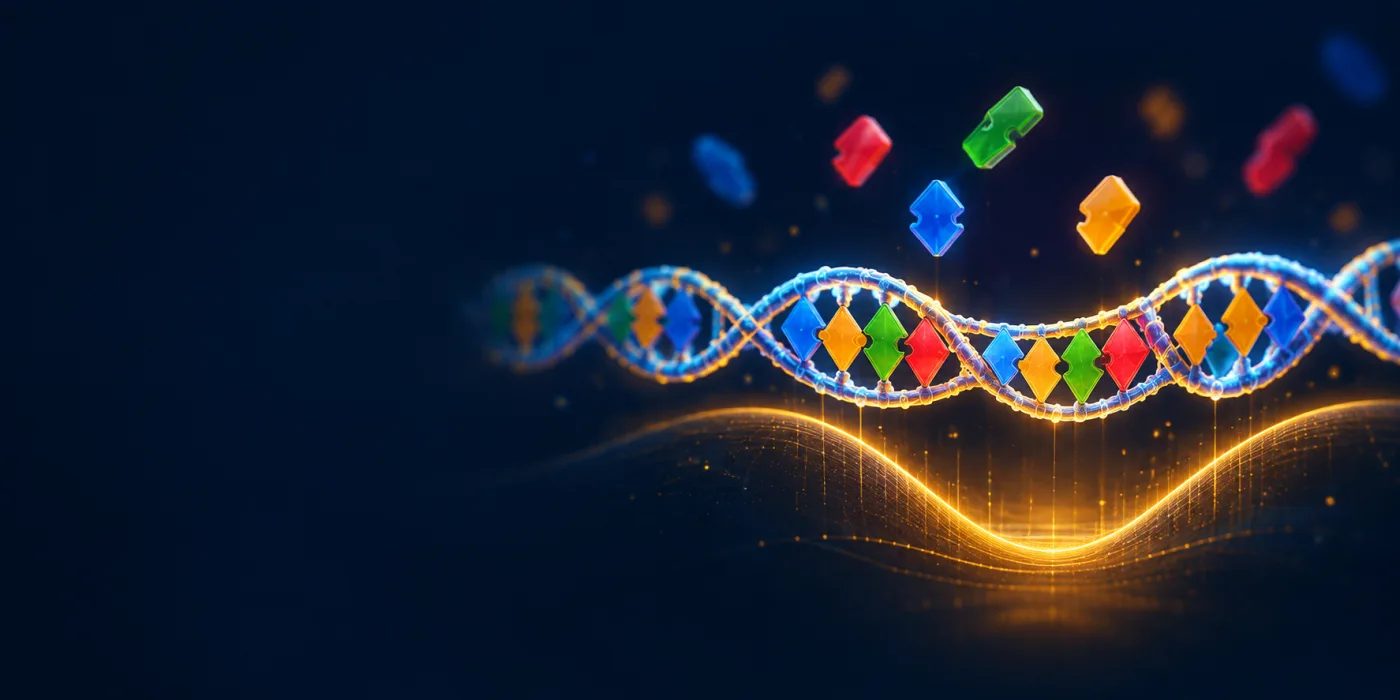
In This Article
- A Computer That Computes by Settling Down
- The Irish Team Behind the Scaffolded DNA Computer
- The Energy Bill Behind Thermodynamic Computing
- Can a DNA Computer Really Solve Problems Without Error Correction?
- From Half a Minute to Twenty Hours: The Timeline
- From Test Tube to 25 Positions: Where the Idea Goes Next
Most computers work like a strict teacher, burning energy to stop every wrong answer from appearing. A new DNA computer does the opposite. Built at Maynooth University in Ireland, it lets molecules drift downhill until the right answer is the only place left to settle.
Published in Nature on 16 September 2026, the machine ran ten programs, including the addition of two 25-bit numbers. So how does a test tube compute by doing almost nothing?
A Computer That Computes by Settling Down
Picture a marble rolling around inside a bowl. No matter where it starts, it ends at the lowest point. Now imagine the bowl is shaped so that its lowest point spells out the answer to a sum.
That is the idea behind the Scaffolded DNA Computer (SDC), a form of thermodynamic computing, where a system's natural pull toward its lowest-energy state does the work. Its programs include Multiplication-by-3, Division-by-2, 8-bit parity detection and 25-bit addition.
The scale is modest so far, and the authors say much remains to be understood. The bigger question is who built it, and why they bet on such a strange idea.
The Irish Team Behind the Scaffolded DNA Computer
The work comes from the Hamilton Institute and the Department of Computer Science at Maynooth University. Damien Woods, Tristan Stérin, Abeer Eshra, Constantine Glen Evans and Janet Adio share the byline, with Stérin and Eshra credited as equal first contributors.
The authors declare a financial interest: Stérin, Eshra and Woods are named inventors on pending patent applications covering the core principles. Readers should weigh that alongside the results. Their motivation starts with a bill that every data centre pays.
The Energy Bill Behind Thermodynamic Computing
Computers, like living things, stay away from equilibrium, the calm state where nothing changes. They burn energy constantly to keep errors out. The paper points to a massive gap between what modern machines consume and the minimum that physics requires.
Molecular computing has the same habit. Since Leonard Adleman's 1994 Science paper showed that DNA could solve a route-planning puzzle, many DNA computers have depended on carefully timed reactions that leak, stall or need manual cleanup.
The SDC flips the goal. Instead of policing errors, it makes the correct output the most comfortable state, so wrong answers fade on their own. Does that hold up once the molecules get busy?
Can a DNA Computer Really Solve Problems Without Error Correction?
Yes, at small scale. On four-position systems, the correct output emerged with no added error-correcting machinery, and four-bit addition averaged 96.7% estimated yield. Yield means the share of molecules that formed the correct structure, judged against controls.
Tiles, scaffolds and a jigsaw that fits one way
Think of a jigsaw where every slot has several candidate pieces, but only one combination fits all its neighbours. In the SDC, one long DNA strand called the scaffold provides the slots. Short DNA pieces called tiles compete to fill them, and each tile carries coded bits on its left and right edges.
The scaffold idea borrows from DNA origami, where one long strand is folded into shapes by short helper strands. Tiles are mixed in roughly ten-fold excess, so every slot gets a candidate.
Matching edges lock together. A mismatch costs energy, so the wrong tile gets swapped out until every edge agrees. For addition, the answer is the only arrangement with zero mismatches.
Reading the answer with light
A fluorescent dye and a quencher, a molecule that switches the glow off, report each output bit. A dim signal means 0 and a bright one means 1.
The most surprising part is what the team left out. The molecules were never steered along a particular path, and the compute strands needed no purification. A plain cooldown did the job.
"Our approach is perhaps comparable to that of DNA origami, in which assembly kinetics is not precisely controlled, yet the design works beautifully."
Stérin, Eshra, Evans, Adio and Woods · Nature, 2026Then the team turned the dial toward speed, and the lab equipment ran out of room first.
From Half a Minute to Twenty Hours: The Timeline
A typical run cools the sample from 80 °C to 20 °C in three hours, then holds it for 45 minutes. Super-fast runs dropped from 80 °C to 55 °C in under a minute and still separated 0 from 1 on small systems.
Accuracy pays for that speed. Mean yield for addition slipped from 96.7% to 82.4% at the one-minute mark, which the authors call the fastest non-trivial programs in the DNA computing literature. A 20-hour hold after cooling showed neither leak nor slow completion, in line with theory.
Adding two fresh strands and reheating flipped a bit-copying program 25 times with little loss of signal.
The paper took over two years to reach print, from receipt on 21 May 2024 to publication on 16 September 2026. Small systems are the easy part. Long scaffolds are where the trouble starts.
From Test Tube to 25 Positions: Where the Idea Goes Next
Every experiment ran in a 96-well PCR plate, in 35-microlitre samples, a fraction of a teaspoon.
Scaling up meant borrowing DNA from the M13 virus as a cheap scaffold. Its slots bind with wildly uneven strength, so wrong arrangements could look more comfortable than the right one. A design trick called isoenergetic programming, which gives configurations with the same number of mistakes similar energy, smoothed the landscape.
The payoff was mixed but real: a bit copied across 20 positions with 71% yield, and across 25 positions with 59% yield, on a 14-hour anneal.
Limits remain. The SDC has real costs, including the number and length of strands plus heating and annealing. Applying the idea to data storage, RNA or protein is still a proposal, not a result.
So what happens when the answer is simply the easiest place to rest?
- Answers by equilibrium. The correct output is the lowest-energy state, so wrong answers fade without added error correction.
- Small but reusable. Four-position systems reached about 96% yield and reran up to 25 times.
- Scale is the open test. At 25 positions yield fell to 59%, so larger machines need better energy design.
Sometimes the answer does not come from pushing harder. It comes from shaping the ground so the right outcome is the easiest one to reach, then giving things time to settle. It is an old human lesson, now shown in a drop of DNA.
📄 Source & Citation
Primary Source: Stérin, T., Eshra, A., Evans, C. G., Adio, J. & Woods, D. (2026). A thermodynamically favoured molecular computer. Nature, 657. https://doi.org/10.1038/s41586-026-10996-5
Authors & Affiliations: Damien Woods, Tristan Stérin, Abeer Eshra and Janet Adio (Maynooth University, Ireland); Constantine Glen Evans (Evans Foundation for Molecular Medicine, USA); Stérin also at prgm.dev, France.
Data & Code: Python code, qPCR protocols and analysis scripts are on Zenodo (doi.org/10.5281/zenodo.15869377). Source data accompany the paper.
Key Themes: Thermodynamic computing · Scaffolded DNA · Equilibrium computation · Renewable circuits · Energy landscapes
Supporting References:
[1] Rothemund, P. W. K. (2006). Folding DNA to create nanoscale shapes and patterns. Nature, 440:297–302.
[2] Adleman, L. M. (1994). Molecular computation of solutions to combinatorial problems. Science, 266:1021–1024.
[3] Petrack, J. et al. (2026). Scaling up thermodynamically favoured scaffolded DNA computing by sculpting the energy landscape. Proc. DNA32, vol. 387.
No comments yet. Be the first to share your thoughts.
Leave a Comment