 Sanjay Verma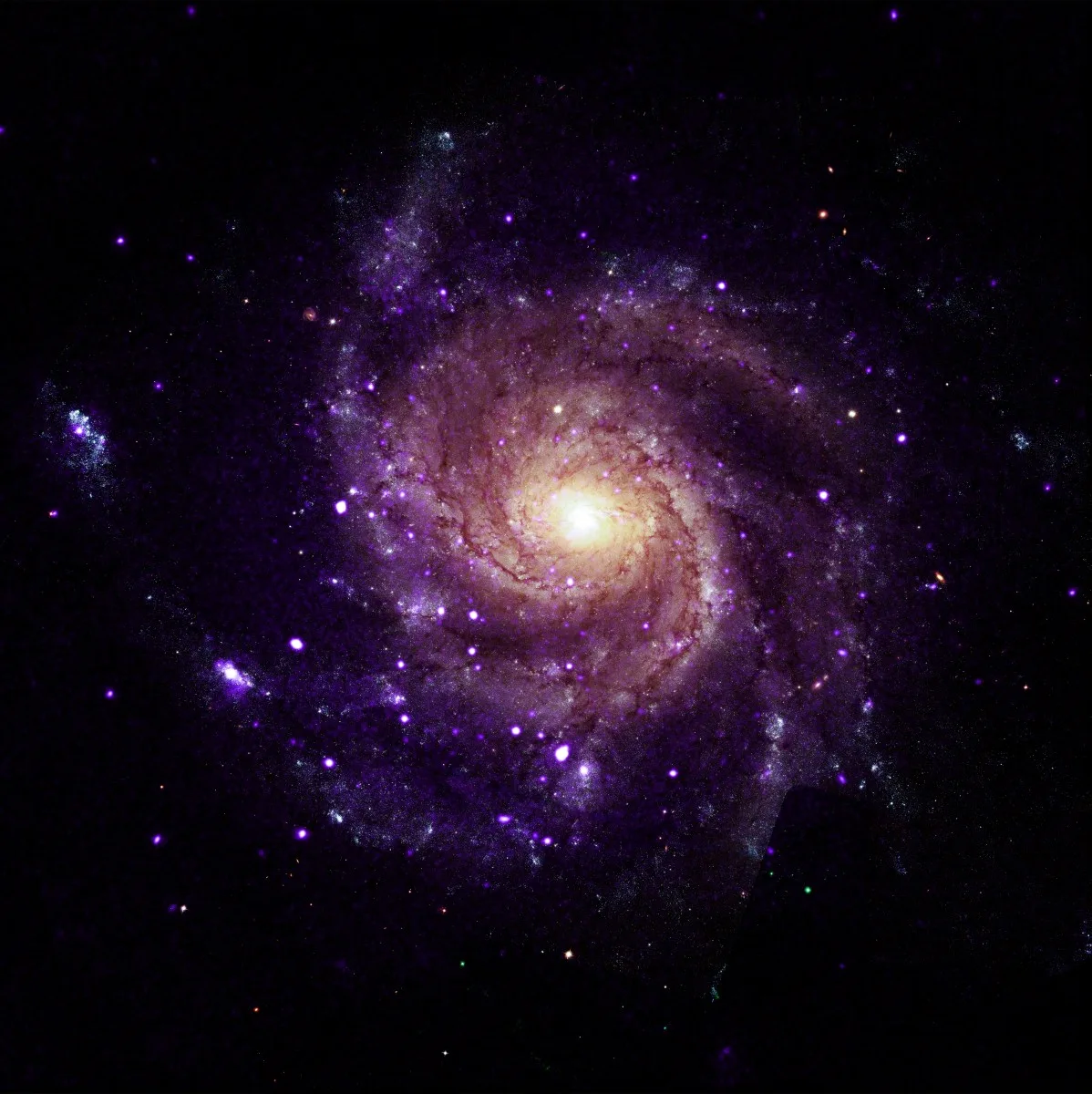
In This Article
- The Speck of Light That Wasn't Behaving Like the Others
- A Team That Went Looking in Data Nobody Had Finished Reading
- How a Blind Spot in the Sky Hid 84 Objects for Decades
- The Two Cosmic Mysteries These Objects Might Help Solve
- Where the Search for Hypersoft Sources Goes Next
Seven faint specks in the Pinwheel Galaxy look, to the untrained eye, exactly like the thousands of ordinary star pairs scattered around them. Astronomers now know they are not ordinary at all.
Using NASA's Chandra X-ray Observatory, a team led by the University of Alabama found 84 objects across six galaxies that behave unlike anything in the existing catalogue. The discovery, published Wednesday in Nature Astronomy, may help crack two problems that have puzzled astrophysicists for decades. So what exactly makes these specks so strange?
The Speck of Light That Wasn't Behaving Like the Others
Every object in space gives off X-rays across a range of energies, from soft to hard. These newly found objects broke that pattern: they showed up clearly in Chandra's lowest-energy X-ray images, then vanished almost entirely at higher energies.
That lopsided signature told the team something important. Low-energy X-rays sit right next to ultraviolet light on the electromagnetic spectrum, so an object pumping out unusually soft X-rays is likely pumping out intense ultraviolet radiation too. Researchers named the class "hypersoft X-ray sources" for that very low-energy glow.
Two of the six galaxies are spirals: M101, the Pinwheel Galaxy, and M31, the Andromeda Galaxy. The other four are elliptical galaxies, and the objects turned up in both young star-forming regions and older stellar neighbourhoods alike. Who actually went digging through the data to find them?
A Team That Went Looking in Data Nobody Had Finished Reading
Mustafa Muhibullah of the University of Alabama led the study, with co-authors Jimmy Irwin, also at Alabama, and Rosanne Di Stefano of the Center for Astrophysics at Harvard and the Smithsonian.
None of the team pointed a telescope at anything new. They combed through images already sitting in the public Chandra archive, searching for objects visible only in the observatory's lowest-energy channel. It is a reminder that some of astronomy's biggest finds now come from re-reading data nobody had fully mined yet.
"We've never encountered a group of objects that act like this."
— Mustafa Muhibullah, University of Alabama, lead authorNASA's Marshall Space Flight Center manages the Chandra program, while the Smithsonian Astrophysical Observatory runs its science operations from Cambridge, Massachusetts. That combination of a two-decade-old public archive and a fresh pair of eyes is exactly why the objects took so long to surface.
How a Blind Spot in the Sky Hid 84 Objects for Decades
The short answer: these sources are very good at hiding. Low-energy X-rays are notoriously hard for space telescopes to detect in the first place, which already made the objects easy to miss.
The bigger obstacle sat in the gas between the stars. The intense ultraviolet radiation these objects give off gets absorbed almost entirely by hydrogen and helium filling interstellar space, creating what researchers describe as a nearly impenetrable barrier to seeing through. Combining a faint signal with a natural cosmic filter is about as good as camouflage gets.
The team's best guess for what is behind the disguise: a black hole, neutron star, or white dwarf pulling material from a companion star, heating that stolen gas until it glows. Such binary systems are familiar to astronomers, just never before seen shining quite this brightly in ultraviolet and this dimly in higher-energy X-rays. Why does spotting them now matter so much?
The Two Cosmic Mysteries These Objects Might Help Solve
Because two separate puzzles may share the same missing piece. Some white dwarfs pulling mass from a companion eventually explode as Type Ia supernovae, the exploding stars astronomers use as reliable distance markers to measure how fast the universe is expanding.
Researchers have hunted for these progenitor systems for years, hoping to catch one before it detonates rather than reconstructing the blast afterward. Hypersoft X-ray sources fit the profile of exactly the kind of accreting system that theory predicts should exist in that pre-explosion phase.
The second puzzle involves the thin gas drifting between stars inside a galaxy. Something is stripping electrons from that gas, a process that shapes how quickly new stars can form. Hot, massive stars only partly explain the effect, and researchers now think the intense ultraviolet glow from hypersoft sources could be doing much of the rest of that work.
Neither mystery is solved yet. The paper offers a plausible new suspect for both, not a confirmed culprit, and that distinction matters for what comes next.
Where the Search for Hypersoft Sources Goes Next
The next step is identification, not celebration. Astronomers still need follow-up observations, likely combining X-ray, ultraviolet and optical data, to confirm what individual hypersoft sources actually are and whether they really do sit on the path to a Type Ia supernova. See the original NASA image release for the full annotated view of M101.
The archive angle also points somewhere useful. If 84 of these objects were hiding in six galaxies' worth of already-public Chandra data, similar searches across the observatory's full archive could turn up many more, since the technique needs no new telescope time at all.
- A new class, not a one-off. Eighty-four objects across six very different galaxies rules out a fluke or instrument error.
- Old data, new eyes. The find came entirely from reprocessing public archive images, not new observing time.
- Two mysteries, one suspect. The same objects may explain both missing supernova progenitors and interstellar gas ionization.
Sometimes the universe's next big clue is not hiding across some unexplored patch of sky. It is sitting in a folder of old images, waiting for someone to look at the data in a slightly different light.
📄 Source & Citation
Primary Source: Muhibullah, M., Irwin, J., Di Stefano, R. et al. (2026). Discovery of a class of hypersoft X-ray sources. Nature Astronomy. Published 9 September 2026.
NASA Coverage: NASA Science, "NASA's Chandra Unveils Mysterious X-Ray Objects," science.nasa.gov; image release via nasa.gov, 22 September 2026.
Authors & Affiliations: Mustafa Muhibullah and Jimmy Irwin (University of Alabama); Rosanne Di Stefano (Center for Astrophysics | Harvard & Smithsonian). Chandra program managed by NASA's Marshall Space Flight Center; science operations by the Smithsonian Astrophysical Observatory's Chandra X-ray Center.
Image Credit: X-ray: NASA/CXC/Univ. of Alabama/M. Muhibullah et al.; Optical: NASA/ESA/STScI; Image Processing: NASA/CXC/SAO/N. Wolk.
Key Themes: Chandra X-ray Observatory · Hypersoft X-ray sources · Type Ia supernovae · Interstellar medium · Pinwheel and Andromeda galaxies
No comments yet. Be the first to share your thoughts.
Leave a Comment