

Stars need fuel to form. That fuel is molecular gas, a cold kind of gas. If a galaxy runs short of it, the galaxy can make fewer stars. Now a study has found a faraway galaxy group where this may have happened.
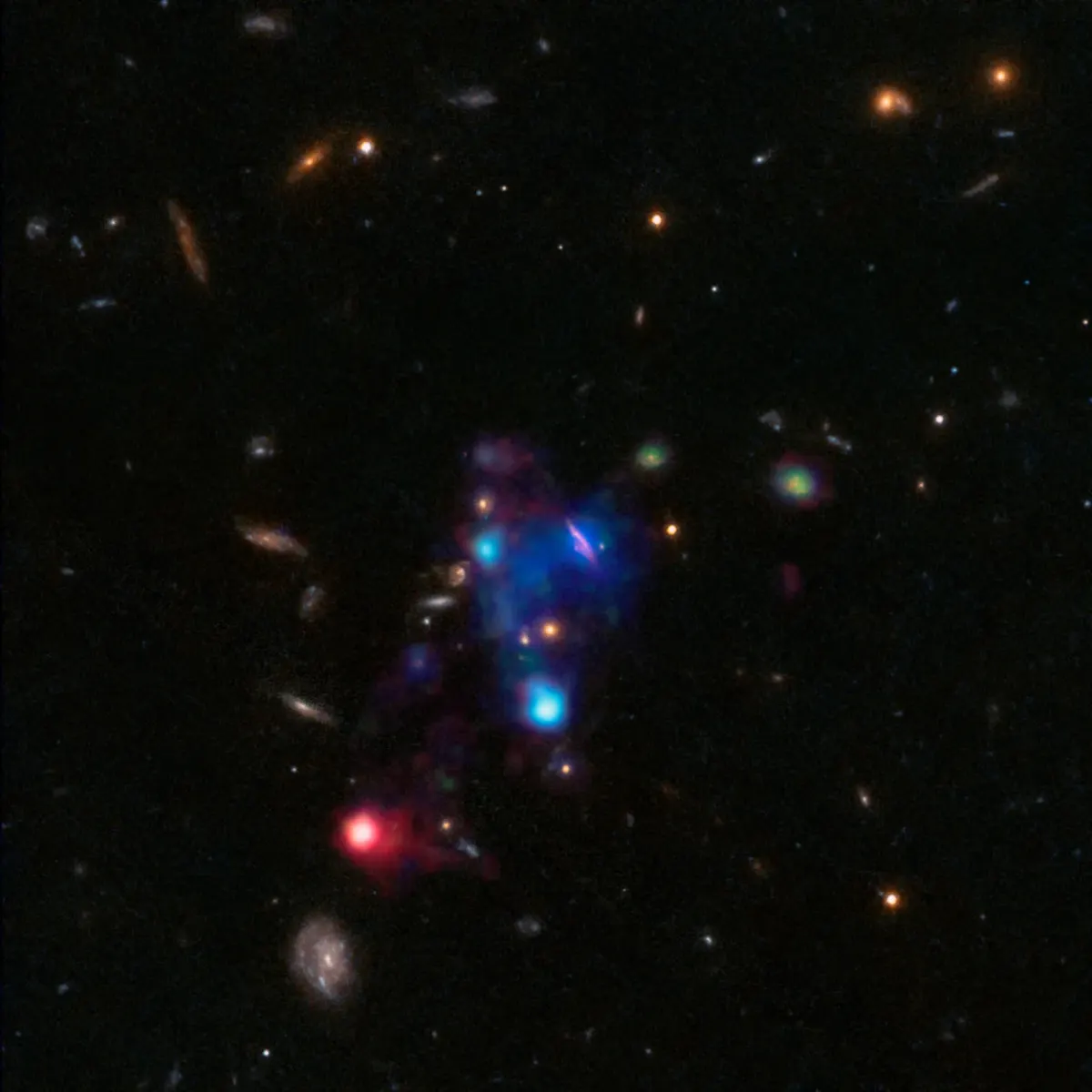
A galaxy group is a family of galaxies held together by gravity. This one is called COSMOS-Gr30. Astronomers have confirmed 44 galaxies in it. It is the most crowded of 14 groups studied with the same instrument. It also sits where threads of the cosmic web cross. That is the huge network of galaxies and gas across the universe.
ESO puts the group about 6.5 billion light-years away. That means we see it as it looked about 6.5 billion years ago.
A giant cloud of glowing gas
In 2017, astronomers found a huge cloud of glowing gas in it. They spotted it with MUSE, an instrument on ESO's Very Large Telescope in Chile. ESO says it spans more than 300,000 light-years, three times the width of the Milky Way.
Eight of the group's galaxies lie inside this cloud. The cloud weighs about as much as 50 billion Suns. The true figure is between about 20 and 80 billion.
The 2017 team also asked what kind of gas this is. It seems to be non-primordial. Primordial gas is original gas from the early universe. The team favoured another story. In it, tides and an active black hole pulled the gas out of the galaxies.
An active black hole sits at a galaxy's centre, feeding on gas and glowing brightly. The team thinks close meetings between galaxies set it off.

How much cold gas is left?
The new study asks: how much cold gas do the group's galaxies still hold? Jonathan Freundlich of the University of Strasbourg led the team.
They used two radio telescopes run by IRAM, the Institute for Millimetre Radio Astronomy. NOEMA, in France, watched 17 of the galaxies for about 12 hours. The 30-metre telescope, in Spain, added about 9.5 hours.
The team looked for carbon monoxide, which glows in radio waves and tracks molecular gas. A conversion factor then turns that glow into an amount of gas.
The glow was clear in four galaxies. For the other 13, the team could only set upper limits. An upper limit means the gas is at most a certain amount. So the team stacked the data. Stacking means adding the signals together to bring out faint ones.
What they found
On average, the group's galaxies hold only 20% to 40% of the usual molecular gas. Usual here means typical main-sequence galaxies. These are ordinary star-forming ones. The researchers write that this "suggests that environmental processes efficiently deplete molecular gas reservoirs".
The 30-metre telescope also checked the glowing cloud. Less than a third of the cloud's gas, it found, is cold and star-forming.
What could take the gas away?
The researchers name several possible causes. The first is tidal interaction, the pull of galaxies on each other. When galaxies pass close, that pull can drag gas out. The second is ram-pressure stripping. A galaxy moving through the hot gas between galaxies feels a push. That push can strip out its own gas.
The third is strangulation. A galaxy normally gets fresh gas from the space around it. Strangulation means that supply is cut off.
Gas can also leave from within. Star formation and outflows from active black holes can blow it out. In their conclusions, the researchers write that this gas "was likely expelled from the galaxies".
What is still unknown
The researchers are open about the limits. They say the uncertainties are significant. Only four of the 17 galaxies were detected. Star-formation rates and the carbon monoxide conversion are both uncertain. And this one group may not be typical of others.
Next, they call for deeper observations with NOEMA, the 30-metre telescope and ALMA. They write that ALMA "may also reveal the molecular counterpart of the extended gas structure".
Together, the researchers say, these results capture "quenching processes in action". Quenching is the shutting down of star formation.
At NavsoraTimes, we find it striking that surroundings may shape how many stars a galaxy makes.
COSMOS-Gr30 still holds 20% to 40% of the usual gas. Around it glows a cloud of gas that was likely pushed out.
📄 Source & Citation
Primary source: Freundlich, J. et al. (2026). Probing the molecular gas content of galaxies in an over-dense group at z ∼ 0.7: A test case for environmental quenching. Astronomy & Astrophysics, 715, A221. https://doi.org/10.1051/0004-6361/202661635
Also used: Epinat, B. et al. on the glowing gas of COSMOS-Gr30, arXiv:1710.11225; and ESO Picture of the Week potw1746a (13 November 2017). Free copy of the main paper: arXiv:2606.26320.
Comments
No comments yet. Be the first to share your thoughts.
Leave a comment