 Sanjay Verma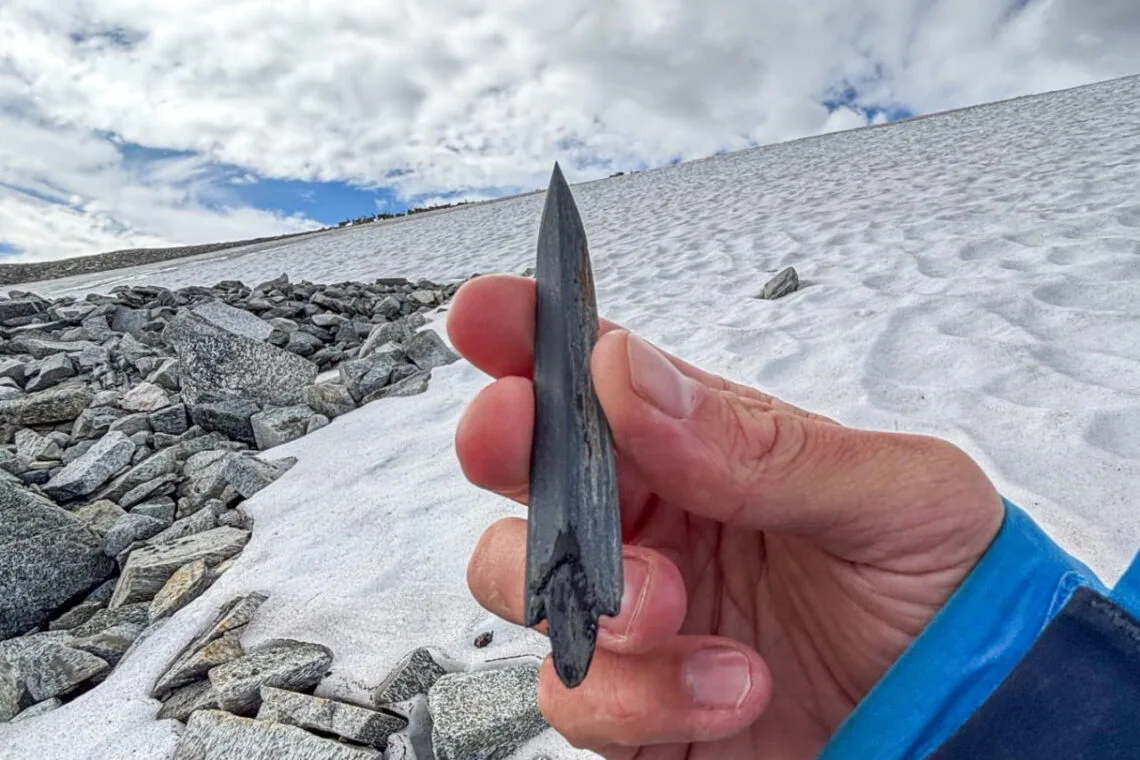
In This Article
- An Arrowhead That Has Outlasted Five Thousand Winters
- The Team That Has Watched This Mountain Melt for Twenty Years
- Why the Ice Keeps Handing Over Older and Older Objects
- How a Lost Arrow Survives Five Millennia in Place
- A Closing Window Before the Ice Is Simply Gone
Somewhere on a Norwegian mountainside, a hunter missed a reindeer roughly five thousand years ago. The arrow buried itself in the snow, and the snow eventually became ice, and the ice held onto that small failure for longer than the pyramids have stood.
This September, that arrow finally came back. It is one of 48 prehistoric arrows recovered from melting ice in Norway's Jotunheimen mountains this year, and it may be the oldest object the site has ever given up. So why is this particular patch of ice suddenly yielding finds this old?
An Arrowhead That Has Outlasted Five Thousand Winters
The arrow carries a fine slate arrowhead, fragments of its wooden shaft, and traces of the prehistoric bindings that once held the two together. Archaeologists estimate its age at 5,000 to 6,000 years, placing it firmly in the Stone Age, long before Norway had anything resembling a written record.
The find comes from the Kvitingskjølen mountain area of Jotunheimen, one of several ice patches researchers surveyed this year. It sits alongside a broader pattern: more objects now date to the Stone Age and Bronze Age, and some finds across the wider programme stretch back more than 6,000 years. Who has been tracking that shift, year after year?
The Team That Has Watched This Mountain Melt for Twenty Years
The work comes from the Glacial Archaeology Programme in Innlandet, known publicly as Secrets of the Ice. This year marks the programme's 20th anniversary, and researchers spent three weeks this season working across the Langfonne, Storfonne, and Handklefonne ice patches.
Since the programme started in 2006, its teams have recorded 73 archaeological sites and recovered more than 5,000 artifacts in Innlandet county alone. Photographer Åsa Rommetveit Celius and archaeologist Espen Finstad, both with the Innlandet County Municipality, documented this season's recovery.
"Sometimes, when an arrow missed its target, it burrowed itself deep into the snow and was lost."
— Lars Holger Pilø, co-director, Secrets of the IcePilø has described that pattern before, from earlier seasons of the same long-running project: a missed shot, a lost arrow, and an accidental five-thousand-year time capsule. The mystery is why the ice is only handing back its oldest secrets now.
Why the Ice Keeps Handing Over Older and Older Objects
Because the newest ice always melts first. Mountain ice patches build up in layers, like a badly organised filing cabinet where recent years sit on top of ancient ones. As warming strips away that top layer, researchers are reaching further back in time with every retreating metre.
This year's survey found large areas where ice had vanished outright, exposing ground that had stayed covered for millennia. The oldest surviving ice, unsurprisingly, is producing the oldest finds. It is a bittersweet kind of archaeology: the worse the melt, the better the discoveries, at least for now.
None of this works, though, without the accident of extreme cold preserving what should have rotted away long ago. How does a wooden arrow shaft survive five thousand winters intact?
How a Lost Arrow Survives Five Millennia in Place
Frozen conditions essentially paused time. Wood, sinew, hide, and textile all decay quickly once exposed to air, insects, and microbes. Locked inside ice at a consistent, near-freezing temperature, those same materials can survive largely untouched for thousands of years.
That is why the programme's haul goes well beyond arrows. Researchers have also recovered bows, clothing, shoes, packhorse gear, and everyday objects, most of it linked to ancient reindeer hunting in the high mountains, where hunters historically tracked herds onto the ice to escape summer insects.
The preservation ends the moment the ice releases its grip. Once exposed, the clock restarts, and decay from weather and microbes can undo in a season what cold protected for millennia. That urgency is exactly why the field season moves as fast as it does.
A Closing Window Before the Ice Is Simply Gone
Based on the retreat observed over the past 20 years, researchers expect ice at many archaeological sites to disappear completely within about two more decades. That estimate turns the fieldwork into something closer to triage than routine excavation.
Objects exposed by melting ice often start decaying almost immediately, so teams need to document and recover them soon after they surface, sometimes within the same season they appear. This year's field work in Jotunheimen is still underway, with researchers securing new finds before conservation work begins.
- Older finds, faster melt. The shift from Viking Age to Stone Age discoveries tracks directly with how much ice has been lost.
- A narrowing window. Exposed organic material decays quickly, giving archaeologists only a short span to recover each find.
- A finite site. If current melt trends hold, some ice patches could vanish, along with whatever they still hold, within about 20 years.
Some of this year's oldest pieces are already sitting in a refrigerated display at the Norwegian Mountain Museum in Lom, visible to visitors just days after coming out of the ice. It is a strange kind of timing: a hunter's five-thousand-year-old miss, on public view within the week.
📄 Source & Citation
Primary Source: Radley, D. (2026). 5,000-year-old arrow emerges as Norway's melting mountain ice reveals older archaeological finds. Archaeology News Online Magazine, 27 September 2026. archaeologymag.com
Research Programme: Glacial Archaeology Programme, Innlandet County Municipality ("Secrets of the Ice"). More information at secretsoftheice.com.
Photo Credits: Åsa Rommetveit Celius and Espen Finstad, Innlandet County Municipality; Live Andrea Sulheim, Norwegian Mountain Museum.
Key Themes: Glacial archaeology · Stone Age Norway · Climate change and heritage loss · Jotunheimen ice patches · Reindeer hunting archaeology
Supporting References:
[1] Pilø, L. H. et al. (2020). Interpreting archaeological lithic and organic implements from the Langfonne ice patch. The Holocene.
[2] Secrets of the Ice field reports, Kvitingskjølen and Trollsteinhøe sites, Jotunheimen, Innlandet.
No comments yet. Be the first to share your thoughts.
Leave a Comment