

Astronomers have completed a detailed study of 172 nearby RR Lyrae stars, building a dataset that could help improve how distances to stars and galaxies are measured. The research combines observations across multiple wavelengths with precise distance measurements from the European Space Agency’s Gaia mission and iron-abundance measurements from a spectroscopic catalogue.
The study is titled RR Lyrae stars as distance indicators. I. Sample selection and characterisation. It was led by M. Sánchez-Benavente of the Instituto de Astrofísica de Canarias (IAC) and the University of La Laguna in Spain, and M. Monelli of INAF’s Abruzzo Astronomical Observatory in Italy, alongside an international team of researchers. The paper has been accepted for publication in Astronomy & Astrophysics (preprint on arXiv).
It is the first paper in a series. It does not yet present the new distance calibrations that are the main goal of the project. Instead, it establishes and characterises the stellar sample needed to develop them in a companion paper.
Why RR Lyrae Stars Matter
RR Lyrae stars are old, low-mass variable stars. Astronomers class them as Population II stars, the older generation of stars in our galaxy. They are found throughout the Milky Way and the Local Group. Their brightness changes as they pulsate, producing repeating patterns in their light over periods of a few hours to about a day.
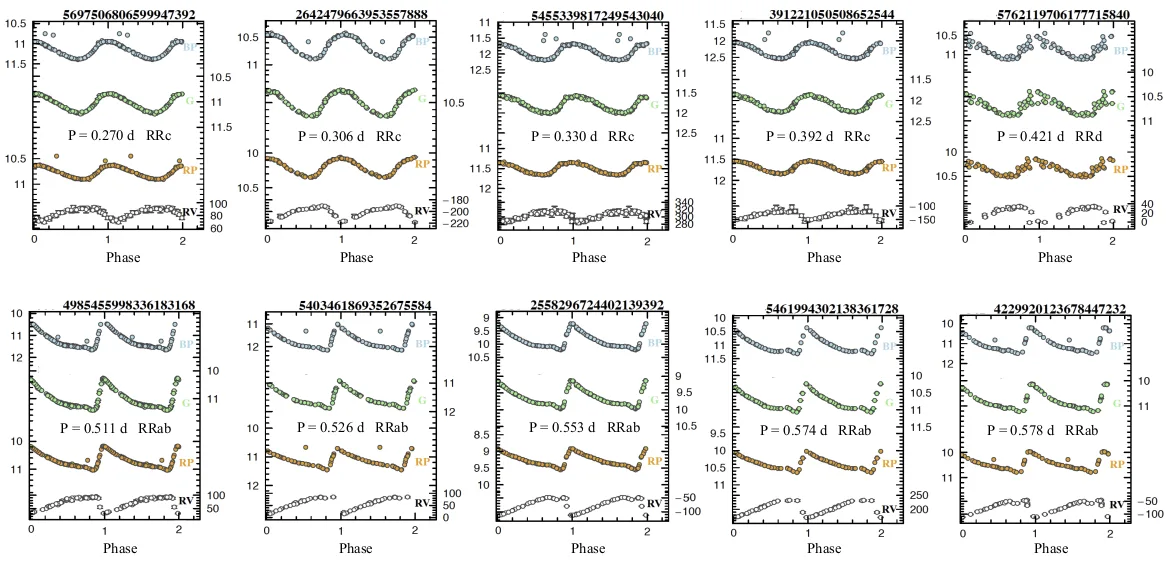
These patterns provide useful information about the stars. Astronomers can study their pulsation periods, brightness changes and light-curve shapes to investigate their physical properties.
RR Lyrae stars are already established distance indicators. Researchers use relationships between their pulsation periods, metallicities and luminosities to estimate how far away they are. Here, metallicity means how rich a star is in elements heavier than hydrogen and helium.
One important relationship is called the period–luminosity–metallicity, or PLZ, relation. It connects a star’s pulsation period and chemical composition with its true brightness. Comparing that true brightness with how bright the star looks from Earth tells astronomers how far away it is.
The authors note that Gaia’s parallaxes now allow these relations to be anchored to geometric distances with unprecedented precision. That offers an independent route to the extragalactic distance scale, the ladder of methods astronomers use to measure distances to other galaxies.
However, earlier empirical calibrations faced several limitations. Their samples often combined observations taken with different instruments and at different times. Some had limited infrared measurements, inconsistent metallicity scales or distance measurements with substantial uncertainties.
The new study was designed to address these issues together.
A Multi-Wavelength Study of 172 Stars
The researchers observed 172 bright, nearby RR Lyrae stars in the Milky Way’s field population, meaning stars that are not part of clusters. Their observations covered optical and near-infrared wavelengths.
The optical observations included 101 stars measured in the Johnson–Cousins UBVRI filters using the IAC80 telescope at Teide Observatory in Tenerife, Spain. The near-infrared observations covered 130 stars in the JHKs bands using the InfraRed Survey Facility in Sutherland, South Africa. Fifty-nine stars appeared in both datasets.
The team also used Gaia Data Release 3 parallaxes to anchor the stars’ distances to geometric measurements. A parallax is the tiny shift in a star’s position as Earth orbits the Sun, and it gives a distance without assumptions about the star itself. Iron abundances came from the Spectroscopic Rome RR Lyrae Catalog. Of the 172 stars, 167 had iron-abundance measurements, including 145 based on high-resolution spectroscopy.
The sample covers a broad metallicity range, from approximately −3.4 to +0.2 dex in [Fe/H]. On this scale, 0 is the Sun’s iron content, and −3 means about one-thousandth of it. The sample therefore includes both very metal-poor and metal-rich stars.
To build reliable light curves, the researchers combined their observations with measurements from Gaia and used different modelling approaches for optical and infrared data. They also applied statistical methods to estimate the mean brightness, amplitudes and other properties of the stars.
Three Important Results from the Light Curves
The study reports three main findings about how the stars pulsate. RR Lyrae stars come in types: RRab stars pulsate in their fundamental mode, RRc stars in their first overtone, and RRd stars in both at once.
First, the researchers found tight relationships between the Fourier phase parameter ϕ31 measured in different optical and Gaia bands and its value in the V band for RRab stars. ϕ31 is a number that describes the shape of a star’s light curve. The intrinsic scatter was very small, below 0.06 according to the paper’s summary and below 0.07 in its conclusions. These relationships can help convert measurements between different filters and support comparisons between surveys.
Second, the ratio between near-infrared and optical amplitudes, or how much the brightness swings in each kind of light, increases steadily with pulsation period. The researchers did not find the break at a particular period reported in several globular-cluster studies. They suggest that the earlier break may come from sample selection, because globular-cluster stars are metal-poor and share a single metallicity, unlike the broad range in their field-star sample.
Third, the team produced a homogeneous calibration of the intrinsic colour at minimum light, the star’s true colour at its faintest point, across filter combinations ranging from U−B to H−Ks. The study found significant links with pulsation period and, for combinations involving the bluer U and B bands, with metallicity.
The researchers tested these colour relationships against data from 44 globular clusters. They also used the calibration to estimate reddening, the dimming and reddening of starlight by dust, for 15 stars outside the coverage of existing three-dimensional dust maps.
The Next Step in the Distance Measurements
The researchers note that some parts of the sample are relatively small. In particular, the RRc and RRd groups have fewer stars. Only ten RRc and two RRd stars have both optical and infrared data, so relationships derived for these subclasses carry larger uncertainties and should be treated as indicative.
The reddening estimates also rely on an assumed extinction law that may not account for variations along different lines of sight.
The main purpose of this first paper is to establish a consistent observational and methodological foundation. In the next paper, the team plans to use the dataset to derive empirical period–luminosity–metallicity, period–Wesenheit–metallicity and luminosity–metallicity relations. A Wesenheit magnitude combines brightness in two filters in a way designed to cancel out the effect of dust.
Those calibrations are the next stage of the project. For now, the researchers have assembled a chemically diverse sample with multi-band observations, Gaia-based geometric distances and a largely high-resolution spectroscopic metallicity scale.
📄 Source & Citation
Source & Citation: Sánchez-Benavente, M., Monelli, M., et al. (2026), “RR Lyrae stars as distance indicators. I. Sample selection and characterisation”, Astronomy & Astrophysics (accepted 10 October 2026) — A&A manuscript · arXiv:2611.33269
Comments
No comments yet. Be the first to share your thoughts.
Leave a comment