

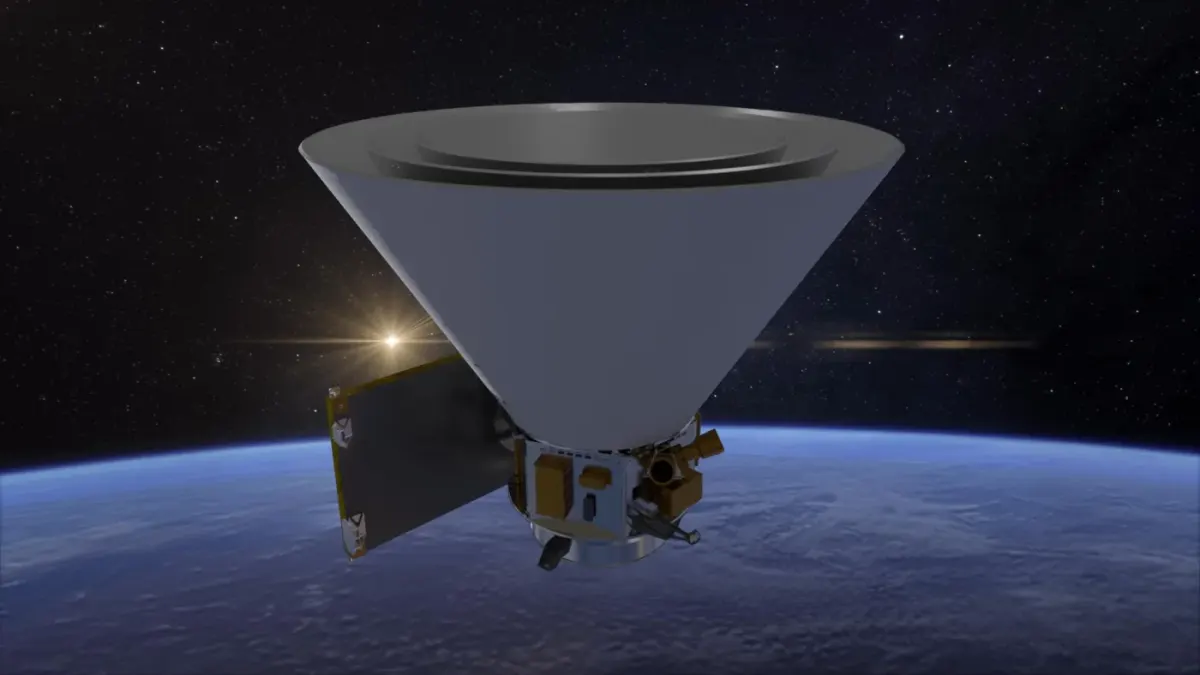
The centre of our galaxy is full of stars. So why can’t we see it?
On 25 November 2026, NASA’s Astronomy Picture of the Day answered that question with a short video. It shows the middle of the Milky Way through the eyes of NASA’s SPHEREx space telescope. In one view, the centre is almost completely hidden. In another, it shines through.
The difference is not the stars. It is the kind of light SPHEREx is looking at.
A galaxy full of dust
The Milky Way is not empty between its stars. It is filled with tiny grains of cosmic dust.
This dust comes from stars. When stars die, they release tiny bits of material into space. Over the Milky Way’s roughly 13 billion years, that material has built up. Today, thick clouds of dust lie between Earth and the centre of our galaxy.
Here is something to think about. The dust that hides the galaxy’s heart was once part of stars that lived and died long before our Sun was born.
Hidden at one colour, clear at another
SPHEREx sees in infrared light. This is light with longer wavelengths than the colours our eyes can see.
In the NASA video, each false colour stands for a different wavelength of infrared light.
At a wavelength of 1.2 microns, in the near-infrared, the dust absorbs and scatters the light. So the centre of the Milky Way looks almost completely blocked.
But here is the catch. At longer wavelengths, in the mid-infrared, the light can pass through the dust. As NASA’s caption puts it, “In the mid-infrared, though, light is able to pierce through the dust and reach SPHEREx.”
Yes, you read that right. The same patch of sky can look dark or bright, depending only on which kind of light you use.
Like a red sunset, but not quite
NASA compares this to something we see on Earth: a red sunset. When the Sun is low, its light passes through a lot of air. Some colours get scattered away, and the Sun looks red.
NASA says the effect in the video is similar, but not exactly the same. Dust in space and air on Earth do not work in quite the same way. The comparison is a helpful picture, not a perfect match.
What is SPHEREx?
SPHEREx is a NASA space telescope that went to space in March 2025. Its job is to map the whole sky in infrared light.
It does this in 102 different infrared colours. It completed its first map of the entire sky using observations made between May and December 2025.
“The superpower of SPHEREx is that it captures the whole sky in 102 colors about every six months,” said Beth Fabinsky, the SPHEREx project manager at NASA’s Jet Propulsion Laboratory.
With so many colours, SPHEREx can see things a single picture would miss. The dusty centre of our galaxy is a good example.
Who made the video?
The video uses SPHEREx data from NASA/IPAC’s public sky archive. It was put together by The Bright Nobles team (Muhammet Mücahit Soylu, Serdar Aydın and Furkan Küpeli) and ChronosphereX.
At NavsoraTimes, we love moments like this. A cloud of dust that hides the heart of our galaxy can, with the right light, become a window instead of a wall.
📄 Source & Citation
Source & Citation: NASA Astronomy Picture of the Day — SPHEREx Seeing Through Dust (25 November 2026) · NASA/JPL — NASA’s SPHEREx Observatory Completes First Cosmic Map Like No Other (18 December 2025)
Comments
No comments yet. Be the first to share your thoughts.
Leave a comment