

Why are early galaxies so bright?
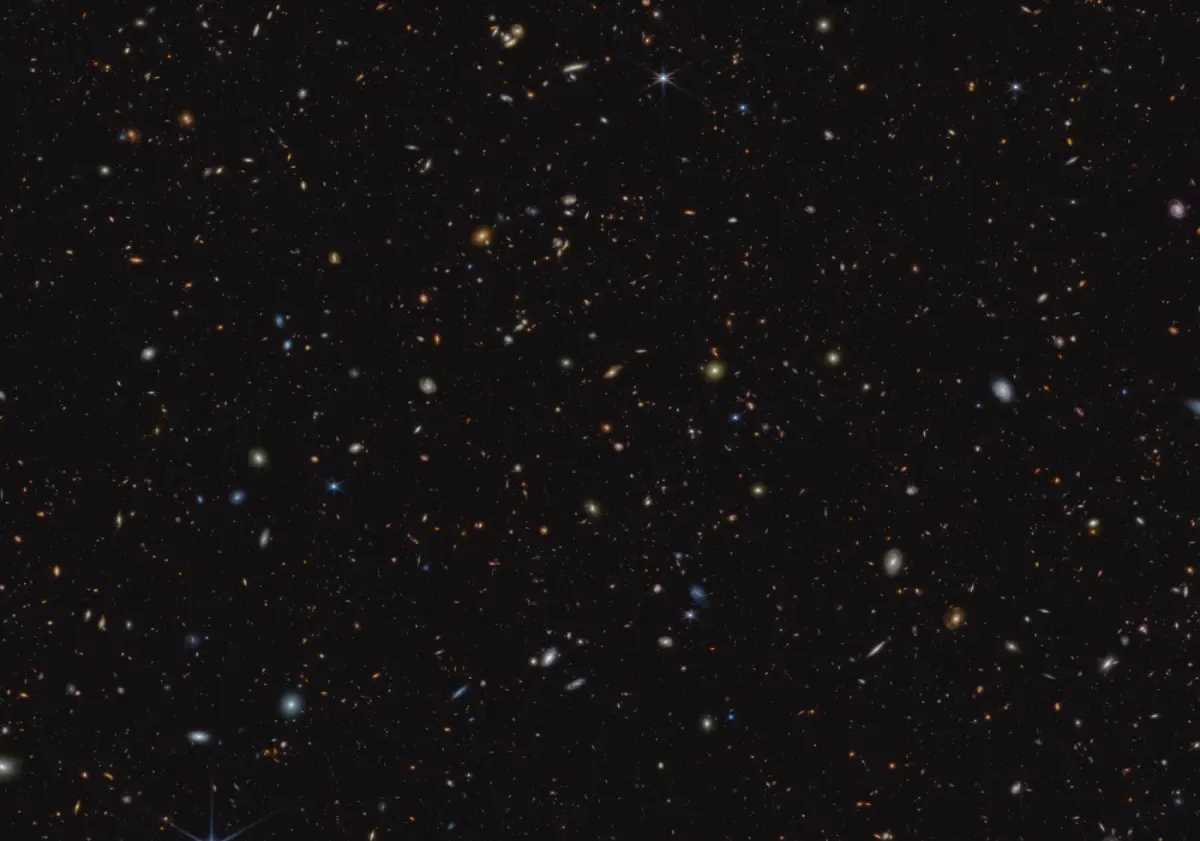
Some galaxies in the early Universe appear brighter than scientists expected. Observations from the James Webb Space Telescope (JWST) have revealed many distant galaxies from the Universe's first few hundred million years.
Their light has travelled for more than 13 billion years to reach us. It offers a view of a time when the Universe was still young.
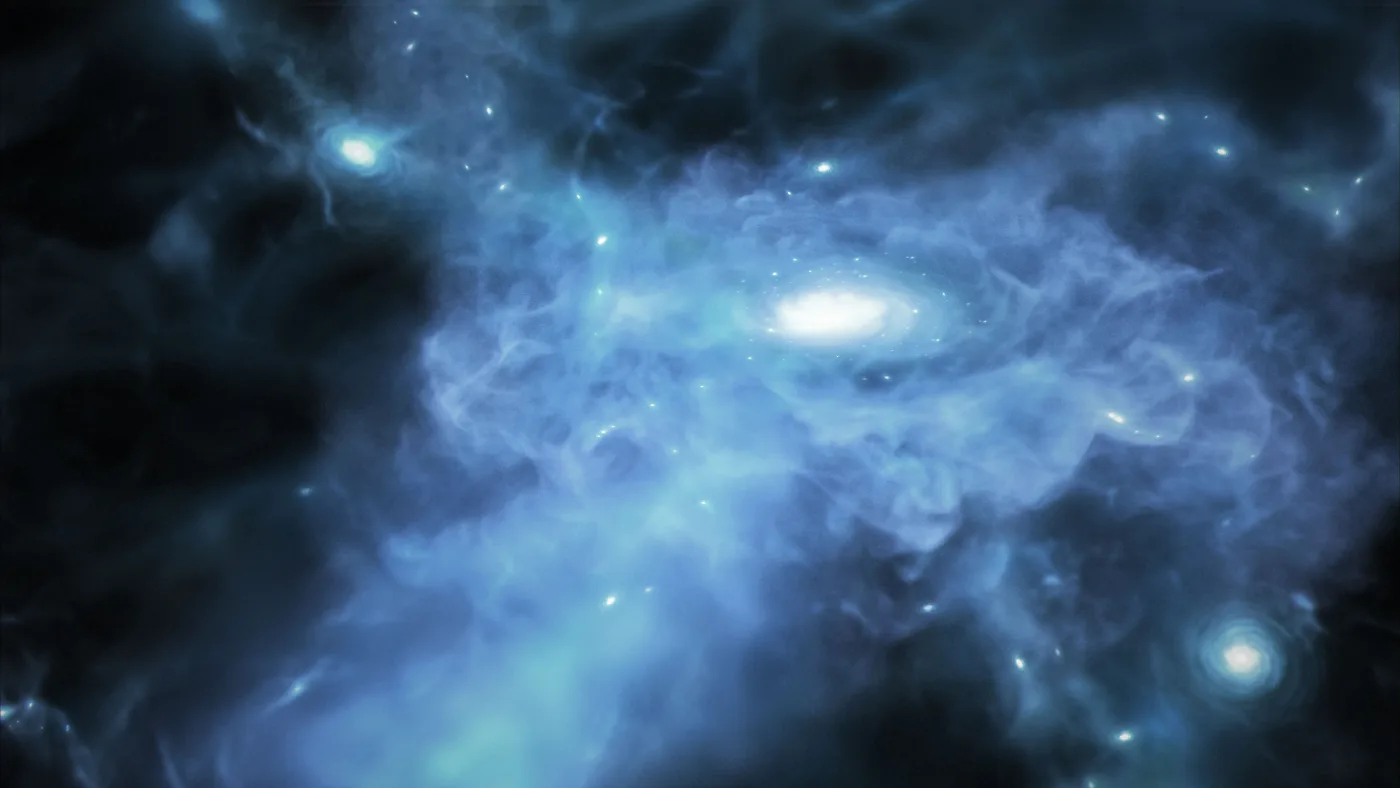
Scientists are trying to understand what made these galaxies so bright. Did they form stars more efficiently? Did they contain less dust? Or did their stars produce more light than expected?
A new theoretical study tests one possible answer. It asks whether early galaxies formed more massive stars than galaxies do today.
The research was conducted by Andrea Ferrara and Pratika Dayal. Their paper, dated November 20, 2026, is available as a preprint.
The researchers found an important limit. Massive stars can increase a galaxy's ultraviolet light. But their effects on surrounding gas and dust reduce much of that brightness advantage.
What does a top-heavy population mean?
Stars are born with different masses. Some are small and faint. Others are much larger and brighter.
Astronomers use the term initial mass function, or IMF, to describe how many stars of different masses form.
A top-heavy IMF means that a larger share of newly formed stellar mass goes into massive stars.
These stars produce strong ultraviolet light. They also produce many energetic explosions called supernovae.
The researchers compared two models. One used the familiar Salpeter IMF. The other used a metallicity-dependent model proposed by Chon and colleagues in 2024.
Metallicity means the amount of elements heavier than hydrogen and helium in a gas. The Chon model becomes more top-heavy when the gas has lower metallicity.
This gives scientists a way to test how early chemical conditions affect the stars that form.
More bright stars bring stronger feedback
At first, the top-heavy model seems to offer a simple solution.
At the same rate of star formation, it produces more ultraviolet light. The study estimates an increase of about 4.7 times in smaller dark matter halos.
In the largest halos tested, the increase is about 2.8 times.
But this is only the light produced by the stars. It does not yet include what those stars do to their surroundings.
Massive stars produce more core-collapse supernovae. These explosions release energy into the gas around them.
That energy can push gas away from star-forming regions. With less available gas, a galaxy may form fewer new stars.
The study finds that this stronger feedback lowers star-formation efficiency.
There is another effect. Supernovae also produce dust.
Dust can absorb and scatter ultraviolet light before it escapes from a galaxy. This makes the galaxy appear less bright in ultraviolet observations.
So the same massive stars that create extra light also bring processes that reduce the light we can observe.
The final brightness gain is much smaller
The researchers included these effects in their calculations. They considered ultraviolet emission, supernova feedback, metal enrichment and dust production together.
The result changed significantly.
For smaller halos, the total ultraviolet boost falls to about 2.0 times. For the largest halos, it falls to about 1.06 times.
The difference matters most for the brightest early galaxies. These are linked to dark matter halos with masses above about 10 billion times the mass of the Sun.
For these halos, the final brightness gain is only about 1.2 to 1.4 times. This is equivalent to roughly 0.3 magnitudes brighter.
The result does not mean that a top-heavy population has no effect. It does make galaxies brighter.
But once feedback and dust are included, the improvement is too small to explain the bright-galaxy excess on its own.
Computer models test the explanation
The team also tested the two stellar populations with the DELPHI semi-analytic model.
First, they changed only the mass-to-light ratio. They kept the other model ingredients based on the Salpeter IMF.
In this test, galaxies became about 1.5 magnitudes brighter. The result could match the observed excess of bright galaxies.
But this test left out an important part of the picture.
When the researchers included the Chon model's supernova rates, feedback, metal production, dust and mass-to-light ratios together, the result was different.
The predicted ultraviolet luminosity functions differed by less than 0.5 dex between the two models. This result held across the studied redshift range, around 11 to 17.
In other words, changing the stars alone can make galaxies look much brighter. Changing the whole system gives a much smaller difference.
Exploding stars may offer a better clue
The study also points to another way to test the stellar population.
It examines pair-instability supernovae, or PISNe. These are powerful explosions linked to a particular range of very massive stars.
The models predict different numbers of these explosions for the two IMFs.
In a typical observed volume of about one million cubic megaparsecs, the Salpeter model predicts around 0.25 PISNe at redshift 10. At redshift 15, it predicts around 0.02.
The Chon model predicts about 0.7 at redshift 10 and 0.1 at redshift 15.
The predicted difference between the models grows with redshift. The Chon model produces about twice as many PISNe per unit volume at redshift 8. This rises to about six times as many by redshift 20.
These numbers are model predictions, not observed detections. The researchers also note that a full calculation of how visible these explosions would be remains future work.
The stars are only part of the story
The study shows why explaining the first bright galaxies is not simple.
A galaxy's light depends on more than the stars it forms. Those stars also affect the gas, the next generations of stars and the dust between us and the galaxy.
A top-heavy stellar population can raise ultraviolet output. But stronger supernova feedback and dust can take away much of that advantage.
For now, the models suggest that massive stars alone cannot explain the bright galaxies seen at cosmic dawn. Finding evidence of their powerful explosions may provide another way to understand what the earliest galaxies were made of.
📄 Source & Citation
Primary Source: Ferrara, A. and Dayal, P. — Top-Heavy Initial Mass Functions Are Not Enough at Cosmic Dawn. Read the research preprint on arXiv
Research note: This article discusses theoretical modelling from a preprint. The predicted pair-instability supernova numbers are not observed detections.
Comments
No comments yet. Be the first to share your thoughts.
Leave a comment